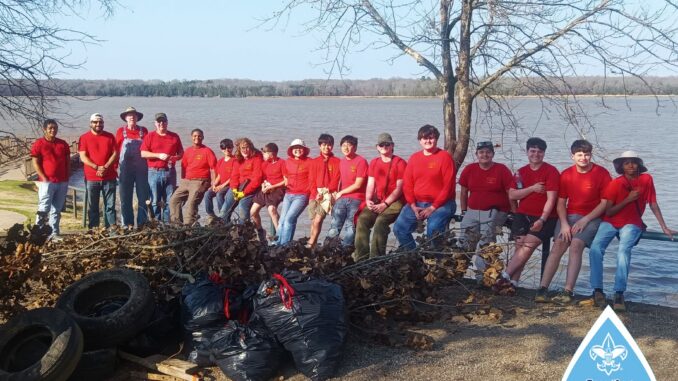
Garbage doesn’t have to be in the water to pollute our rivers, lakes and oceans. That plastic bottle nearly a mile from the lake poses a threat. That fast food bag discarded near a drainage ditch is a danger.
Maybe somebody should step up and do something about it.
Scouts will gladly take that on.
This year’s Scouting for Clean Waterways initiative kicks off April 1 as part of Earth Month. Earth Day is April 22.
Launched last year, Scouting for Clean Waterways is quickly becoming one of Scouting America’s most impactful national service efforts. Clean Waterways encourages Scouts to use less plastic, dispose of trash properly, recycle when possible and help clean up communities. It also shows how much Scouts care about their communities as they volunteer their time to properly discard a shocking amount of garbage.
“Clearing garbage from a local park is a big deal when you think of how easily trash from there can end up in our streams, no matter how far it is from the river or lake,” says Brian Gray, Scouting America’s director of conservation. “The impact Scouting had last year in removing this type of trash was enormous, and it’s only going to be better this time around.”
Last year, Scouts recorded more than 1,151 service projects with 6,832 youth participants and 4,151 unit leaders. They collected 129,985 pounds of trash, including 53,826 pounds of plastic.
But those numbers don’t tell the whole story, as many projects likely went unreported during the program’s first year.
“Reporting is the key,” Gray says. “When we can show our impact with data, it’s even more impressive.”
The Clean Waterways initiative features a tracking system through Scoutbook+. Units log service hours, track participation and quantify their environmental impact in a consistent way. This not only validates the work Scouts are already doing but also provides powerful data to demonstrate Scouting’s value to communities, partners and potential members.
Partnerships have also amplified the initiative’s reach.
Collaborations with organizations like NOAA, the National Marine Sanctuary Foundation and CleanHub extend the impact beyond local communities. For every pound of plastic collected by Scouts, CleanHub agrees to organize collection efforts in developing regions around the world to match that number. With the CleanHub match, Scouting America’s efforts led to more than 100,000 pounds of collected plastic last year.
The initiative also ties into a broader national goal: encouraging every unit to contribute significant service hours as part of the country’s 250th anniversary.
Equally important is the program’s role as a community and recruitment tool. Cleanups often attract family members and volunteers, with participation numbers showing that non-Scouts frequently outnumber registered youth. When communities see Scouts actively improving public spaces, it reinforces the organization’s relevance and inspires others to get involved. As Gray notes, “If we can have Scouts being seen as great stewards of our country and our lands, others will join.”
Here’s how to get involved:
Scouting for Clean Waterways projects can be held anytime. The most popular times are between April and June, when the cleanups can be tied to Earth Day or a Scouts Trash the Trash Day activity.
Dens and packs
Activities can be held anywhere. Community parks and recreation areas, school grounds, and the areas around houses of worship are all ideal candidates for a Cub Scout Scouting for Clean Waterways activity.
Activities should last 1-2 hours.
Dens or packs can organize the activity on their own or participate with community organizations hosting similar activities.
Cub Scout families can be included on any Scouting for Clean Waterways project.
Troops, Venturing Crews and Sea Scout Ships
Our waterways and the areas around them, parks, and other recreation areas are great places to start. Remember that trash on land frequently becomes aquatic trash.
Service projects should last between 2-4 hours.
Units can organize the service project on their own or participate with community organizations hosting similar events.
Councils
Scouting for Clean Waterways service projects can easily be included as part of a council or district event. Councils can also partner with community environmental organizations hosting similar events.
Impact Partners
Program Partners
Reporting Your Event
After the completion of your Scouting for Clean Waterways’ project, we need you to report your event so that we can truly show the ripple effect being accomplished by Scouting America units. If you are doing the project as an individual or unit, please have your leadership report it through Scoutbook+. Click here to learn how to record it. This way the individual Scouts will get the information recorded on their records. If the council or district is doing the event as a large event, click here for fillable PDF and then email the completed form to cleanwaterScouts@scouting.org
Click here for more information.
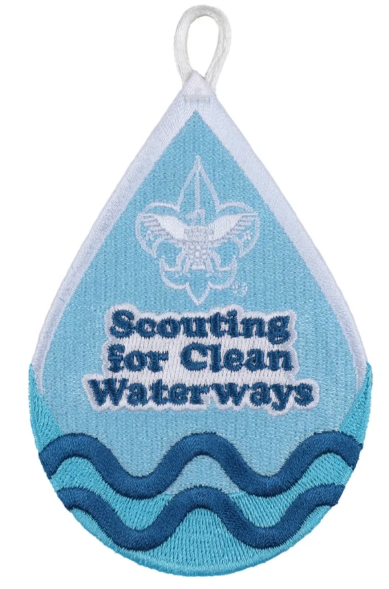
Get the Scouting for Clean Waterways patch!
Celebrate environmental stewardship with the Scouting for Clean Waterways emblem, symbolizing your efforts to reduce aquatic trash and protect ecosystems. T-shirts for men, women and kids are also available.