Emergencies happen when you least expect.
For Tree Kiester, Scouting America’s national director of environmental health and safety, the mindset of “being prepared” is the ultimate survival skill to start with.
“The world can be big and scary, but adventure is out there,” Kiester says. “Preparing yourself just a little bit means that when you get out there, you can use whatever’s around you.”
So here are a few skills Scouts know that could help you or your fellow Scouts in an emergency.
- Turn a neckerchief into a life-saving tool
A Scout neckerchief (or any triangular cloth) is one of the most versatile items you can carry.
When better supplies aren’t available, use a neckerchief for things like:
- A sling: Fold into a triangle, place under an injured arm and tie it behind the neck.
- Bandage: Fold into a strip and wrap around a wound to hold gauze in place.
- Pressure wrap: Tie firmly on or right above a bleeding area to help slow blood flow.
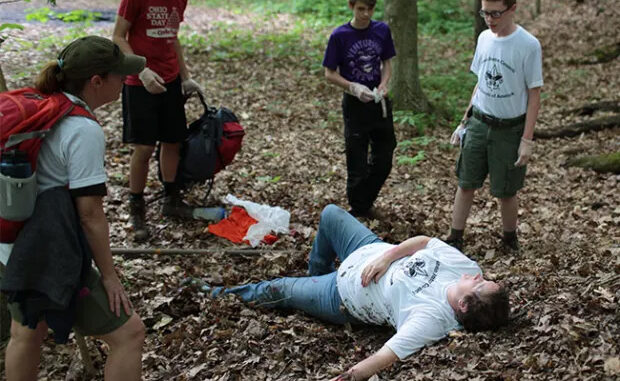
Kiester used these exact skills during a rafting trip when his sister-in-law suffered a severe arm laceration. After cleaning and covering the wound, he secured it with a triangular bandage like a Scout neckerchief.
And he’d had practice familiar to many a teenage Scout.
“I can’t tell you how many times I put my arm in a sling with my neckerchief just because I was bored,” he says. “Man, did that come in handy.”
If your neckerchief isn’t long enough, tie two neckerchiefs together.
- Improvise a bandage from clothing
No first-aid kit handy? Use what you’re wearing to treat bleeding wounds.
Grab clean fabric (the cleanest part of your T-shirt, spare jogging shorts in your car, a clean blanket, etc.)
- Fold into a thick pad.
- Press firmly on the wound to control bleeding.
- Secure it with a neckerchief or cloth strip.
- Use the ABCs to guide you in a first-aid emergency
From the first-aid merit badge, Scouts learn:
- ABCs (for serious emergencies):
- Airway: Make sure the injured person’s airway is clear.
- Breathing: See if their chest is rising and falling or if air is coming from their mouth and nose.
- Circulation: Check the person’s pulse to determine if their heart is still beating. If not, CPR needs to start.
“Having those basic systems in your head means you’re not guessing. You know what to do next,” Kiester said.
For more mnemonics that could save a life, check out this story.
- Estimate daylight with your fingers
Knowing how much daylight you have can guide smart decisions outdoors (like when you’re hiking in an unfamiliar area or if you need light to see an emergency task you’re completing, such as jumping a car battery).
How to do it:
- Hold your hand at arm’s length between the horizon and the sun.
- Stack fingers upward to fill the gap between the two. (Don’t look directly at the sun.)
- Each finger equals about 15 minutes of daylight remaining.
Preparation is Key
Scouting America’s Scouting Safely resources feature the Guide to Safe Scouting, real-life Safety Moments, Wilderness First Aid tips and more. Remember that the best way to avoid needing survival hacks is to properly plan and Be Prepared.