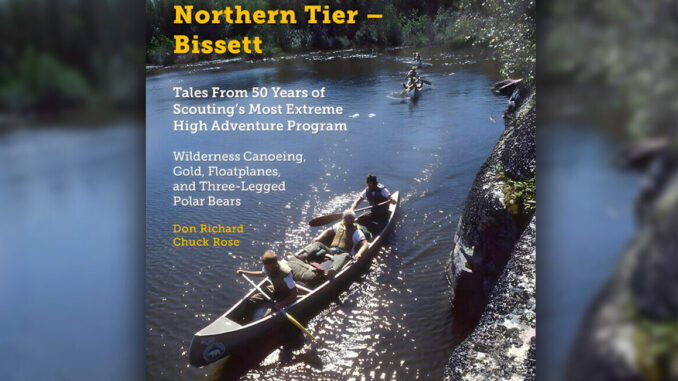
When Don Richard and Chuck Rose set out to write a book on Scouting America’s Northern Tier program in Bissett, Manitoba, Canada, they weren’t sure how long it would take, how long the book would be or what the finished product would look like.
“At first, I thought it might be a pamphlet,” Rose says.
The more Richard and Rose investigated the history of Bissett and the surrounding lakes and streams of Manitoba, the more they realized this project would need, well, more. The result is their recently released book, Northern Tier — Bissett. Tales From 50 Years of Scouting’s Most Extreme High Adventure Program. Filled with maps of original canoe journeys, stories of gold mining, monthlong treks and wild animal encounters, this 155-page adventure was created to celebrate Bissett’s unique role within the Scouting community.
The book is available at the Northern Tier Trading Post online store.
The appeal of Bissett, the authors say, is the remote location. And for the most part, a journey to Bissett is like the first few journeys in the 1970s.
“The gear is better today,” Richard says. “The road there has gotten better over time. But once you get there, the rocks haven’t changed, the water is the same and the fishing is still great.”
Bissett is so remote, it’s currently closed.
A reduction of emergency services forced Scouting America to temporarily halt sanctioned trips to Bissett. For now, the next best thing is to read about Explorer Post 2077, which set off on 375-mile trip from Norway House to York Factory in Manitoba. Chapter 3 recounts how the post from Kansas traveled by canoe for nearly a month. Learn more about Bissett’s use of floatplanes starting in the late 1970s by turning to Chapter 6. Read Chapter 9 to discover the Native-American history of the region known as Pimachiowin Aki, “The Land That Gives Life.”
Both authors have deep personal connections to Northern Tier. Richard’s passion began in 1979 when pictures from a Scoutmaster’s trip to Atikokan, Ontario, convinced his troop to head north. He then worked at multiple bases and returned as an adult advisor. Rose joined Scouts and went on a canoe trip his first week. Hearing about the Northern Tier’s Charles L. Sommers Canoe Base in Ely, Minn., he spent years trying to get there as a youth before deciding in 1980 to simply apply to be on staff.
“I thought I’d work one year, get the patch, and that’d be it,” he laughed. “It didn’t work.”
Nine summers later, he was still there. Northern Tier had become part of his life.
Richard and Rose wrote the book because Northern Tier — Bissett changes lives, they say. And that’s a story worth preserving.
“There’s a connection you immediately have with people who’ve been there,” Rose says. “Whether it was decades ago or just recently, you have similar adventures and stories to tell.”
Interesting facts about Northern Tier — Bissett
The Bissett program came together fast (in a month) despite the 500-mile drive to the Canadian location, many terrible roads and coinciding with the busy summer season of 1972. Chapter 1, page 7.
The amount of gold thought to be in the ground near Bissett — even after several decades of operation — could be higher than when the mine first opened, because explorers and miners keep finding more. Chapter 2, pages 15-21.
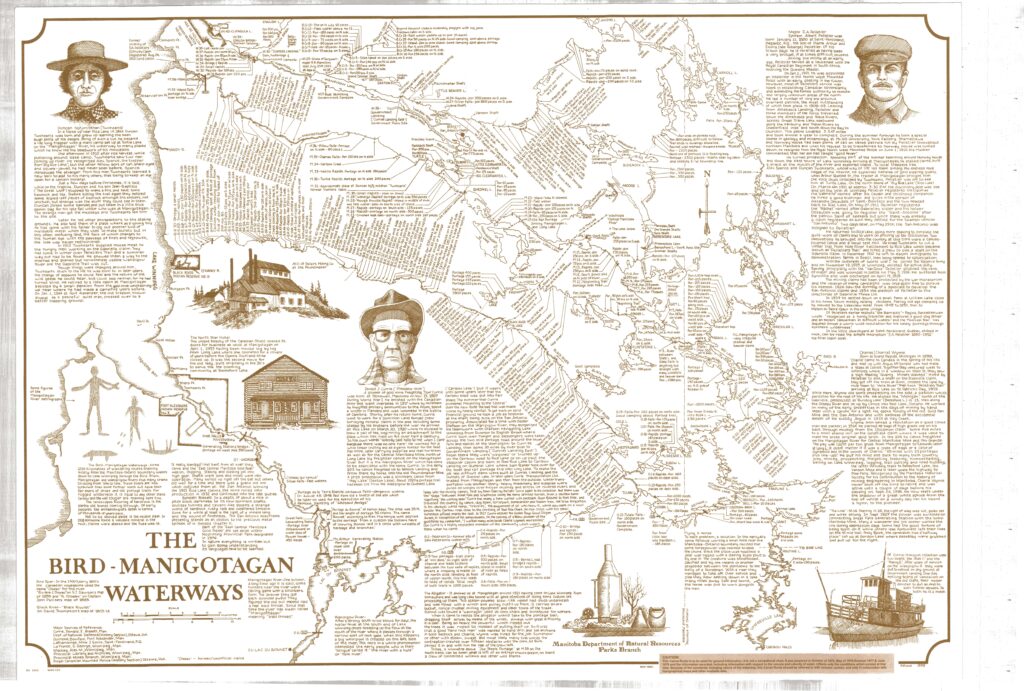
Canadian artist Réal Bérard’s hand-drawn maps were a huge source of inspiration for the start of the Northern Tier — Bissett program. Several of Bérard’s maps were on the walls at the only Bissett building in in the 1980s. Troop leaders spent hours studying these maps and considering potential routes. Chapter 1, pages 3-4; Chapter 3, page 26.
There were monthlong trips by Explorer Posts (now Venturers) in the early 1970s. In addition to the York Factory trip, another crew paddled from Cross Lake (north of Lake Winnipeg) to God’s Lake (totaling 473 miles). Those types of trips were rare then and unheard of nowadays. Chapter 3, pages 23-27 and 35-37.
The first all-female Explorer trip was in 1974. Chapter 3, page 35.
Many, maybe most, of the wilderness paddlers in the area were Scouts. Atikaki Provincial Wilderness Park doesn’t issue permits, but estimates of use by paddlers were about 300 to 400 a year. Chapter 9, page 107. However, Northern Tier did keep track of use (they were paying customers after all), which typically numbered 300 to 500, with a peak of 677 in 2003. Chapter 10, page 114.
Long-serving pilot Jonathan Friesen would reserve the best seat in the floatplane for the smallest Scout. Chapter 10, page 114.
Marc Wermager, a U.S. staff member/guide from the 1960s, developed plans in the 1980s that helped preserve the area. He received advice from wilderness advocate and writer Sigurd Olson, whom he had met as a guide while working for Sommers Canoe Base (what became the Northern Tier program). Ontario’s Woodland Caribou Provincial Park was created in 1983, and Manitoba’s Atikaki Provincial Wilderness Park was developed in 1985. Chapter 9, pages 106-107.
Read an excerpt from Chapter 3 “Beyond the Horizon” about an amazing canoe trip
In 1973, the program that was soon to be known as Northern Expeditions hosted three crews; coincidentally, all three were from Kansas. Two crews explored new (to Scouts) routes out of Wallace Lake, near Bissett, while one crew went even farther north.
Explorer Post 2077 from Ottawa, Kansas signed up for Sommers’s biggest adventure yet (and perhaps the biggest still to this day for the Northern Expeditions program): a nearly month-long wilderness canoe trip. Their destination was York Factory, a major fur-trading center for over 250 years, 375 miles (600 km) downstream on Hudson Bay, and a prime destination for latter day canoe enthusiasts. Led by Advisors Judge Don White and Brad O’Dea, the members of Post 2077 practiced their canoe camping skills on trips to the Quetico through Sommers. Over the years, Judge White developed a close relationship with the Sommers Canoe Base’s Director Sandy Bridges. His son, Tab, recalled that (at the time) the Judge would mention Sandy about three times a day. His involvement with Exploring was also motivated in part by the problems he saw running a juvenile court. He—and others as far back as Plato—believed adventure was part of the solution. That spring, the crew also received expert whitewater training on the Arkansas and Missouri rivers.
This trip was to be their culminating experience. The Judge wrote:
Our Post is canoe-orientated, paddling on the rivers as soon as it is warm enough, followed by going to the Charles L. Sommers Canoe Base each summer to paddle in the Canadian wilderness. The parents have always commented that their son had “grown a little more” after they went through the hardships on a trail; also, that the Exploring program gave them more confidence in themselves.