
Searching for the right commitment to make to yourself, your body and your future in 2026? The Scouts BSA Handbook and countless merit badges are full of New Year’s resolution inspiration.
That’s why we took a look at the Personal Fitness merit badge, earned by tens of millions of Scouts, and hand-selected six goals attainable for adults who want to prioritize their health next year.
Let’s get into how your year could be transformed in a few Scout-approved steps.
Note: These suggestions are for adults looking to take on a fitness challenge. Scouting America encourages youth to join the Scouts BSA program and earn the Personal Fitness merit badge to reflect on their own personal health.
1. Get a physical
Early in the requirements for the Personal Fitness merit badge, Scouts are tasked with discussing the importance of getting a physical exam annually.
Bev Singel, a registered nurse on Scouting America’s health and safety team, explains why it matters.
Annual health and wellness checkups benefit both adults and youth by identifying conditions early, before they become more serious, … They also help to build a strong relationship with a health-care provider and determine baseline health information.
Echoing requirement 2(a) of the Personal Fitness merit badge, Singel suggests monitoring your health is a great place to start for both Scouts tackling the rigors of a physically demanding merit badge and adults who are committed to starting or maintaining a healthy lifestyle. (*Note: Scroll down to check out how preparticipation physical exams could also spark a fitness goal.)
2. Go to the dentist
It’s simple. It should be routine. But we know even some adults skip the recommended twice-a-year dentist visits
Requirement 2(b) of the Physical Fitness merit badge asks Scouts to reflect on how they care for their teeth. And 2026 seems like a great year for you to do the same.
3. Walk or run a mile
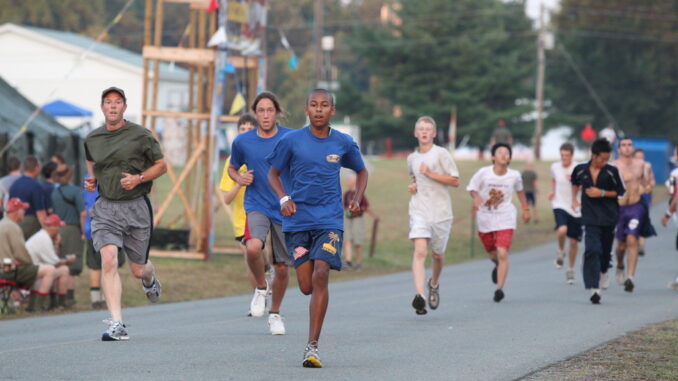
Map out a 1-mile route and walk or run it to measure your cardiorespiratory fitness. Record how long it took you to complete the mile and then challenge yourself to improve your time or simply feel better after completing a mile.
Check out requirement 5 of the merit badge pamphlet to consider factors that may help you improve your 1-mile challenge outcomes.
4. Conduct your own strength test
Requirement 4(b) asks Scouts to measure their muscular strength and endurance and record the results. Below is an excerpt on how to conduct a strength test. Use this to set your own goals for the year (and to formulate your longer-term fitness plan. More on that in resolution #5).
Record either the number of sit-ups done in 60 seconds OR how long a plank was held; AND, record the number of either push-ups OR pull-ups done in 60 seconds …
Resources: Sit-Up (video)
Plank (video)
Pull-Up (video)
Push-Up (video)
Remember, you can make this test your own. If you need to use 30-second increments, that’s OK. If you’d rather do crunches than situps, go for it. If you’re using this as a New Year’s resolution, you’re working to improve your 2026, not earn a merit badge.
5. Create a physical fitness plan (and actually follow through with it!)
In requirements 6 and 7, the Personal Fitness merit badge asks Scouts to create a 12-week fitness plan that includes the following elements in each workout day:
- Warmup
- Cardiorespiratory exercises
- Muscular strength and endurance exercises
- Flexibility exercises
- Cooldown
- A plan to improve diet and nutrition
For you, this could look like blocking out 30 minutes on your calendar three days a week. On each of these days, you might walk half a mile, jog a mile, do 20 pushups, stretch for five minutes, walk another half a mile and swap your post-lunch soda for a green tea.
The exercises, durations, distances and repetitions are up to you. The goal is to commit to a fitness plan on paper, execute it and revise your plan as you’re able to do more.
6. Bonus goal: Preparticipation physical exam
If you attend some Scouting events, like those that last longer than 72 hours, you’re required to do a physical assessment where a physician records your results and assesses if you are fit for certain physically strenuous activities.
Singel gave some great insight on how to use that kind of physical exam as a starting place for a long-term health goal too:
We refer to annual health exams as preparticipation physical exams, which allow for a health-care provider to help you determine your ability to participate in a Scouting activity that may be strenuous. This time with your provider gives you the ability to discuss what your next adventure will include and how you can best be prepared. If you aren’t ready at the time of the exam, your provider may be able to help you take steps to prepare mentally and physically. If it is decided that the upcoming activity isn’t right for you, this is a great opportunity to understand why and how you may be able to change.
Adult leaders especially can set an example by heeding medical advice and showing that the outcome of these exams allows them to tackle adventures their bodies can handle.
Keep yourself physically strong and mentally awake
Don’t forget that mental health is just as important as physical health. The good news is that sticking to a physical fitness goal can boost your mental health. And more good news: Borrowing from the Personal Fitness merit badge means you never have to set foot in a gym, which is likely going to be very crowded with so many other people tackling their physical fitness New Year’s resolutions.
If you’re taking on a wellness goal for 2026, let us know what it is in the comments. If you’re taking on the fitness plan outlined above, what does your plan look like? Please share, as your plan will likely inspire others!
