
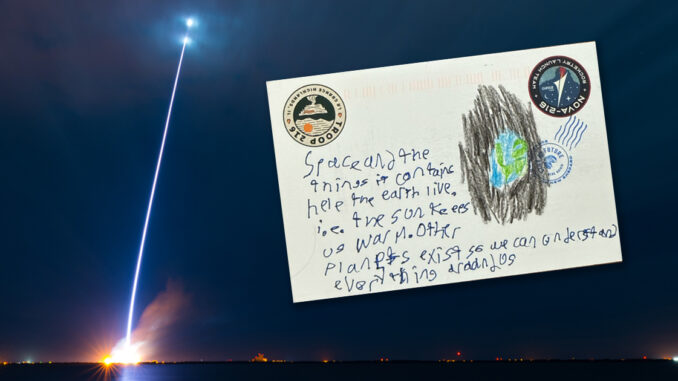
Assistant Scoutmaster David van Alphen was looking for ideas to keep older Scouts in his troop engaged.
“I wanted to do fun projects with them to keep them excited about Scouts,” he says.
Scouting has plenty to accomplish this, and it helps when you put your passions into action. Van Alphen enjoys learning about nuclear science and astronomy, so he taught the Scouts of Troop 216 in La Grange Highlands, Ill., about fusion and rocketry. He organized a group of Scouts to compete in a national rocketry competition. He counseled Scouts working on the Nova and Supernova Awards.
But one of the endeavors involved the Scouts’ handwriting going to space.

Launching with Blue Origin
Blue Origin, a private spaceflight company focused on reusable rockets, started suborbital missions 10 years ago. Since its first launch, the company’s New Shepard rocket has flown more than 35 missions, reaching past the Kármán line (100 km/62 miles) — the internationally recognized boundary of space when crew members experience weightlessness.
Since 2019, Blue Origin has taken 80 people into space. Through the company’s Club for the Future program, people can write a postcard that will be stowed aboard the crew capsule. Hundreds of thousands of physical and digital postcards have flown in a New Shepard rocket since then.
A couple of years ago, van Alphen discovered the program and encouraged Troop 216 Scouts to participate.
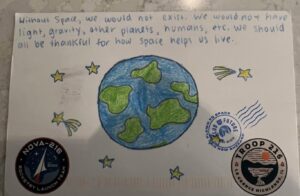
“I created special postcards with the troop logo and a Nova logo,” he says. “I had all the Scouts write a message or do a drawing.”

To space and back
The troop sent in the postcards but didn’t hear back from the company right away. They weren’t sure what happened to their postcards — until a few months ago when Scouts began receiving them back emblazoned with a blue “Flown to Space” stamp.
“I thought it was cool to send something into space and get it back,” says Maksim Libby, 17, an Eagle Scout. “I had totally forgotten about it. But it was nice to see a surprise snapshot from the past.”
The returned postcards renewed the Scouts’ excitement about space. The troop is considering sending more postcards to Blue Origin.
“I think more Scouts should be interested in space exploration because the newer generation needs to think about expanding life into space with future human developments,” says Life Scout Keisha Marsden, 14.
You can do it too
Club for the Future’s Postcards to Space program is still accepting submissions for future missions. You or your Scout can either mail in or a postcard or submit it electronically.
The process opened the eyes of Troop 216’s Scouts to the space industry, including careers.
“You don’t have to be an astronaut,” van Alphen says. “There are artists and mathematicians that work with the space program. It doesn’t mean you have to fly in a rocket.”
A little creativity helped older Scouts’ imaginations take off.
“Carl Sagan famously said, ‘The cosmos is within us. We are made of star-stuff. We are a way for the universe to know itself,’ ” says Sofia LoSavio, 18, an Eagle Scout. “Similarly, Scouting and all these great experiences helped me know myself and get started on my journey in life.”
If your unit has completed a cool project or outing recently, let us know by emailing us at onscouting@scouting.org.

